
The past isn’t the past: why Holocaust denial persists
Content warning: Presented data may contain disturbing language related to online hate speech.
Holocaust denial and holocaust distortion are rooted in antisemitic ideology. Denial refuses to accept the historical reality of the Nazi-led extermination of Jews, while distortion minimises its scale by blaming Jews, downplaying victim numbers, or reframing responsibility for the establishment of concentration camps. Together, they threaten the understanding of the most intensely researched genocide in history. The International Holocaust Remembrance Alliance (IHRA) defines Holocaust denial or distortion as deliberate attempts to excuse or minimise the impact of the Holocaust; grossly understate the number of victims against reliable evidence; blame Jews for their own genocide; portray the Holocaust as a positive event; or obscure Nazi Germany’s responsibility for creating and running concentration and death camps by attributing it to other nations or groups.
Prejudices and discrimination against the Jewish community have a long history. The earliest episode of antisemitic violence dates back to 38 AD in Alexandria, Egypt, and such hostility has continued throughout history, rarely disappearing entirely.
Today, antisemitism can tap into various and distinct ideologies and resurfaces during global crises, for example, by holding Jews collectively responsible for the COVID-19 pandemic or the conflict in the Middle East.
Especially the internet and social media have become fertile ground for spreading misinformation and disinformation on Judaism. Research shows that during the pandemic, in early 2021, antisemitic posts surged, rising seven-fold on French accounts and more than thirteen-fold on German ones compared with the same period in 2020. Holocaust denial and distortion can easily be found across mainstream social media and fringe platforms. In 2022, a UNESCO study found that 16.2% of Holocaust-related content on social media contained denial or distortion. Meanwhile, 90% of Jewish people have themselves encountered antisemitism online. The share of Jewish people experiencing online antisemitic harassment increased from 15% in 2018 to 17% in 2023. Previous analysis also detailed that data specifically identifying Holocaust distortion incidents is still missing, while numbers in antisemitism incidents are growing.
In the aftermath of the October 7th Hamas attacks, antisemitic and anti-muslim content both surged. Previous reports identified a 919% increase in antisemitic content on X and a 28% increase on Facebook, while posts containing antisemitic keywords rose by 25%. On the other hand, Tell Mama UK reported a 300% increase in anti-Muslim prejudice after October 7. Research by the Institute for Strategic Dialogue also showed the sustained anti-Muslim and antisemitic content linked to the ongoing Hamas-Israeli war. This prompted us to monitor both the conversation around Jews and the war in Gaza, and Holocaust denial more closely.
Dashboard analysis - antisemitism channel
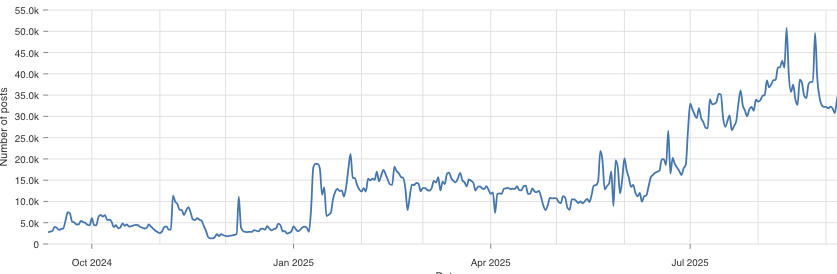
Between April and August 2025, we analysed conversations through our antisemitism baseline channel, which includes neutral keywords including Jew, Jews, Jewish. The channel contained 3.3 million posts, of which nearly 20% were toxic. Most content came from X/Twitter (79%), with posts primarily written in English (52%). The average toxicity score was 0.30, with 1.3% of messages reaching extreme toxicity. Highly toxic posts were concentrated on X/Twitter (85.6%), often linked to racism (81%), and over a third contained violent language (37%). We recorded a sharp increase in the number of posts, rising from 12,090 posts on 1 April to 49,962 by 14 August.
Racism and Religion categories intersected the most (42.99%), followed by Racism and Politics (41.56%).
Racism & Politics
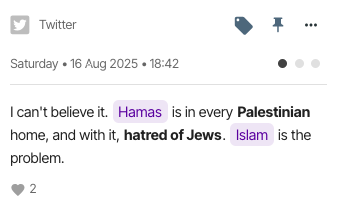
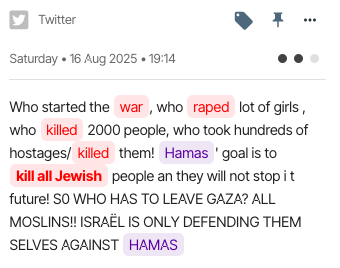
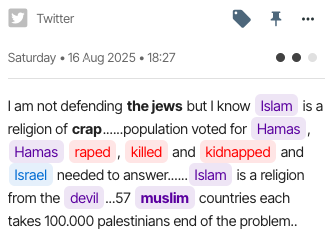
Racism and politics categories emerged as the second strongest intersections, present in 41.56% of all posts. Much of the discourse centred on the ongoing war in Gaza, where polarising and hateful narratives targeted Muslims, Hamas, and Islam, framing them as primarily responsible for political tensions in the Middle East. Keywords reflect this focus, with ‘Hamas’ appearing in 4,457 posts, ‘Muslims’ in 2,466, ‘war’ in 1,452, and ‘Palestinian’ in 992. Almost two years after the October 7 attacks, these findings reveal sustained hateful conversation against Muslim communities, as previous reports highlighted.
To explore Holocaust denial narrative in more depth, we selected keywords such as ‘6 gorillion’, ‘holohoax’, ‘lolocaust’. ‘Holohoax’ and ‘lolocaust’ are commonly used to discredit Holocaust survivors testimonies, dismissing them as unreliable or inauthentic. ‘6 gorillion’ a sarcastic term used to minimise the death toll of the Holocaust. Our analysis between April and September 2025 shows this content is not marginal but highly visible across social media. Posts increased substantially at the beginning of May, peaking from 12 to 40 in just one day. Following this peak, activity remained elevated, with several smaller peaks across the period, indicating sustained engagement after the initial spike.

The dataset was marked by exceptionally high levels of toxicity, with an average score of 0.70, and 13.1% of posts reached high toxicity. Most data was collected from X/Twitter (90%), Gab (6%), and 4Plebs (3%). Almost all toxic content (99%) was flagged under the Untruth category, underscoring the central role of disinformation in driving harmful narratives. Two-thirds (66%) of toxic messages contained violent language. Interestingly, 75.7% of the most toxic content was concentrated on Twitter.
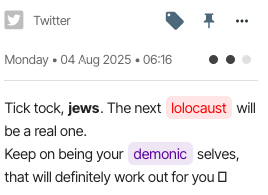
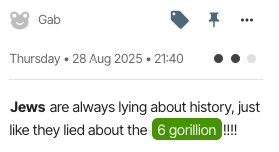
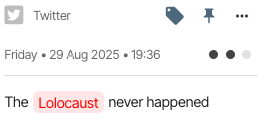
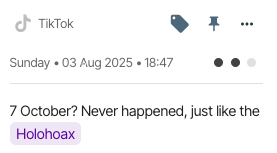
Such posts trivialise genocide, deny historical fact, and weaponise conspiracy theories to spread hostility against Jewish people today.
Legal framework of online Holocaust denial
The European Union has established a series of legal frameworks to prevent hatred against the Jewish community. In 2008, the Framework Decision required EU Member States to criminalise public incitement to violence or hatred based on race, religion, or ethnicity, as well as the denial of serious crimes such as war crimes, genocide, crimes against humanity, and the Holocaust. However, while several EU member states have robust legislation criminalising Holocaust denial, including Austria, Belgium, France, Germany, Poland, Romania, and Slovenia, important gaps remain across Europe. Countries such as Estonia, Sweden, Denmark, and Ireland do not explicitly criminalise Holocaust denial, addressing it only when it overlaps with hate speech or incitement. Also, most national laws that ban antisemitic speech online use terms that depend heavily on interpretation, which means every potentially illegal post has to be judged in its specific context. As a consequence, Holocaust denial often falls into the category of “lawful but awful”, meaning it remains visible online despite its harmful and antisemitic nature.
Is the Digital Service Act curbing illegal antisemitism content?
The Digital Services Act (DSA) includes new obligations for online platforms to act against illegal content, including illegal antisemitic hate speech. It requires platforms to assess systemic risks, set out mitigation measures, act on notices of illegal content, and cooperate with trusted flaggers. In principle, these mechanisms directly support the removal of Holocaust denial and distortion when that content is illegal under national law. However, the DSA defers to existing EU and national definitions of what constitutes “illegal content”. As a consequence, platforms must act to remove Holocaust denial in countries where it is criminal (for example, Germany), while the same content may not be unlawful in other member states. The result mirrors our dashboard findings: antisemitic and denial content continues to circulate widely on social media.
This legal patchwork undermines the DSA’s capacity to provide consistent protection, leaving room for harmful content that threatens democratic discourse and distorts historical truth.
On the other hand, even when not explicitly illegal, it is crucial to address harmful antisemitic disinformation. The example below shows an influential public page known to promote 9/11 conspiracy theories, intertwined with conspiratorial claims about Israeli intelligence, illustrating how misinformation ecosystems actively sustain antisemitic narratives.
Platform stances on Holocaust denial
Most major platforms now list Holocaust denial and distortion within their hate-speech or misinformation rules and have public commitments to remove such content. In June 2019, YouTube revised its hate speech policy to explicitly prohibit content that denies well-documented violent events, including the Holocaust. The ISD recorded a sharp decline in the use of the term “holohoax” across Youtube after this change. This drop illustrates how clear, well-defined policies combined with active enforcement can significantly reduce the visibility of denial content online.
Meta updated its hate speech policy to explicitly ban Holocaust denial after several reports revealed its algorithm was promoting such material. Similarly, TikTok partnered with UNESCO and the World Jewish Congress to promote accurate information about the Holocaust.
Yet, enforcement remains inconsistent. A 2024 analysis noted that platforms often fail to apply their own rules. The Meta Oversight Board expressed concerns over Meta’s failure to remove an Instagram post containing false information about the Holocaust despite its policy.
Way forward
To limit the dissemination of illegal antisemitic content, legal clarity and robust platform procedures must go hand in hand. Clearer, harmonised definitions of what constitutes “illegal content” are essential. This should include explicitly designating certain forms of antisemitic speech or Holocaust distortion as unlawful even when they do not meet the threshold of a criminal offence, ensuring platforms have a firm and consistent basis for removal. Without reducing the problem of fragmented legislation, inconsistent enforcement will continue, as shown in our dashboard analysis. Harmful content will keep circulating, shaping public discourse, fuelling radicalisation, and undermining informed understanding of the Holocaust.
A coordinated European approach is therefore essential to safeguard democratic values and protect historical truth from disinformation and distortion of the Holocaust.